Here I am again with Suzi’s blog site but this is interesting for everyone not just those on Insulin!!!!
http://regularsuzihomemaker.wordpress.com/2013/03/02/its-been-awhile/#comments
Here I am again with Suzi’s blog site but this is interesting for everyone not just those on Insulin!!!!
http://regularsuzihomemaker.wordpress.com/2013/03/02/its-been-awhile/#comments
I got a bit excited on the weekend when I went to the Hervey Bay markets and found a summer spinach. Spinach is such a useful vegetable but with the very hot summers out here, it didn’t make it past November very successfully. Still, I’d had about 6 months out of it.
Otherwise known as Ceylon Spinach or Malabar Greens, this summer growing spinach like plant (Basella alba) grows best on a small 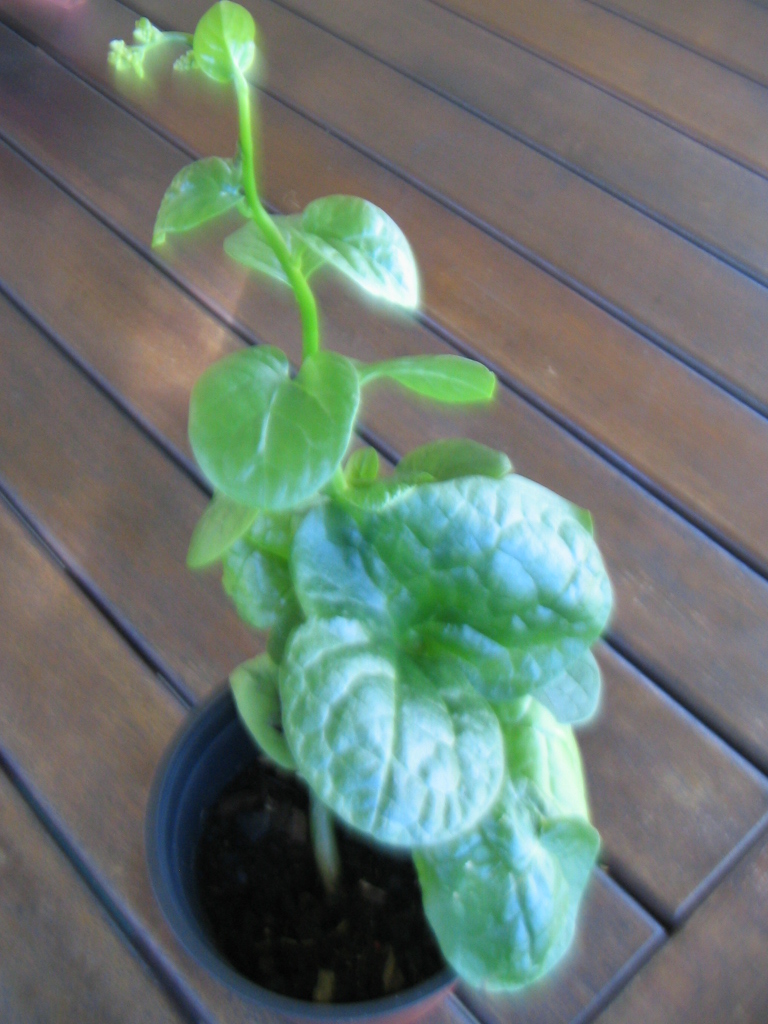 trellis and dies off in winter but is apparently very good at setting seed. Since, I love to find babies in the garden, this plant would suit me well, I thought.
It seemed like the perfect solution, English Spinach, kale and silverbeet in the winter and Malabar Greens in the summer but on a second look and some discussion with the lady who sold the plant to me, we decided it would frost. It is a tropical plant after all. I almost put it back and then thought ‘well, it’s going to die back in winter anyway so let’s find the best spot possible in the garden for it, make sure it has a seed bed and watch what happens. ‘ I do have a back up plan though- I planted one at the house in Hervey Bay as well where the winters are much less harsh and the springs and early summer are more humid. So watch this space…….. and while you are waiting you could also check out these two information sites.
Suzi you will love this one but she does warn you not to use it in your smoothies!!!
http://www.thewellnesswarrior.com.au/2012/02/a-tasty-herb-to-improve-your-digestive-health/
It’s been awhile….This is re-pressed from RegularSuziHomemaker ‘The Whole Journey’ and is a must read if you have any connection to anyone with Type1 diabetes.
Suzi is my daughter and has made the switch to a Plant Based diet. She is very carefully monitoring her insulin levels and general health as is essential for management of diabetes. She has an advantage over most of us, in that she has regular blood tests and check ups and so can get a pretty fair idea of what effect this diet has on her system.
If you have an interest in nutrition for any lifestyle or health issue, you will find this interesting. ‘The Whole Journey’ also has some amazing recipes and food choices for those of us who just appreciate a few more vegies in our diet than most people do.
‘I had a little capsicum’, and I still do.
This little capsicum has been in the garden for almost two years and spent most of last winter hibernating beneath a refrigerator box, but even then, it still produced the odd fruit. It has continued to fruit all through summer, just as it did all last summer. It produces just enough to keep us going and since we eat them on salads and in stir fry and in casseroles, that it not a bad effort for the one little plant.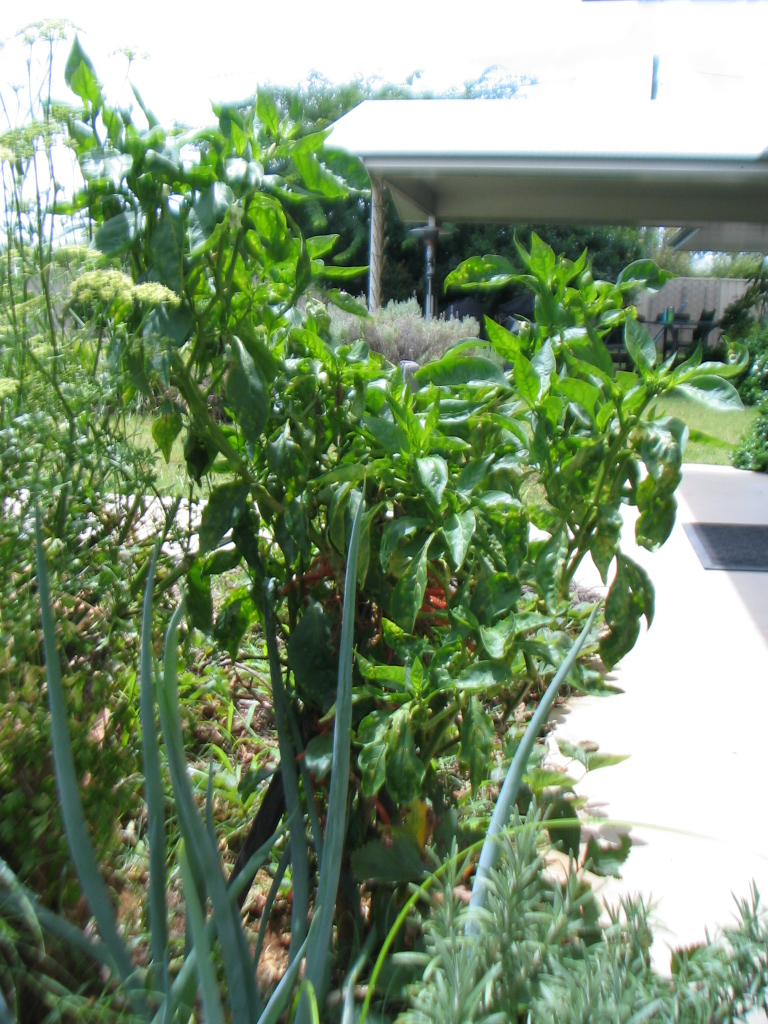
And, it has produced babies with a little help. I talked about that at http://wp.me/p2tNt0-32
The Gardening Australia website http://www.abc.net.au/gardening/stories/s1866669.htm suggests that capsicums are indeed perennial, but usually we treat them as an annual. I sometimes wonder how much of what we assume as home gardeners comes from commercial agricultural practices and how much we need to relearn to be really effective home vegetable producers. The garden is really your best teacher for this so just get in there and give it a go.
The capsicum is also an attractive little plant, so given that it is actually a perennial and that it has lovely glossy green leaves and can have bright green, red, yellow or orange fruit, it is a plant that you could easily use as an ornamental in a spot in which you can protect it in winter. That is, if you get frost as we do.They grow easily in a pot and this probably ideal as the plant can moved in and out of shelter in winter for an all year round boost to both your food dishes and your immune system.
Raw capsicum contains high levels of Vitamin C and also beta carotene which converts to Vitamin A, a great immune system boost.
No, my asparagus does not normally look like this when I pick it. Usually in the six to eight weeks in Spring (here Spring is September to November) that we are picking asparagus, it usually looks like a bed of mulch with spikes sticking out of it. The trick is to eat enough so that you stay ahead of the spikes and it doesn’t get bushy like this.

Asparagus in January
This is December to August bush and it stays this way until I get out the weed eater (brushcutter) and cut it back to ground level in August.
From December to August it doesn’t get watered, it doesn’t get anything but a few weeds pulled. In August we cut it back, throw a pile of compost, horse manure and mulch on top, water it heavily and wait for results. Very, very tasty results whether it is eaten raw and fresh, chopped in a salad or cooked as a vegetable.
Asparagus is dead easy to grow, very hard to kill and the quickest and easiest vegetable to prepare for a meal. What more could you want as the backbone for your garden?
Climate-wise, I grew it in sub-tropical inland Queensland as well as down here near the border with New south Wales.
The people at http://www.nutrition-and-you.com/asparagus.html list the many benefits of asparagus including ‘Asparagus is a very low calorie vegetable. 100 g fresh spears give only 20 calories. More calories will be burnt to digest than gained, the fact, which fits into the category of low calorie or negative-calorie vegetables,’ but to me asparagus is also one of the best and most satisfying vegetables you can grow.
And Double bonus!!! We have just had floods, although my house remained high and dry, but the drenching rain has kick started the asparagus again and we have eaten it every night for the last two weeks. Asparagus in January!!
Well, I don’t know about you but we have been having over 40 degree days here and the nights aren’t a lot better. Like people from the Arab world, we are better to close the house up completely and stay inside where it’s cool than to open it up to the hot wind. At least it is, if your house is designed to do that. If not, then like most Australians, it’s switch on the air conditioner and use even more electricity.
I was also away for twelve days and in that time we had one shower of rain and a neighbour watered once. Needless to say, although all 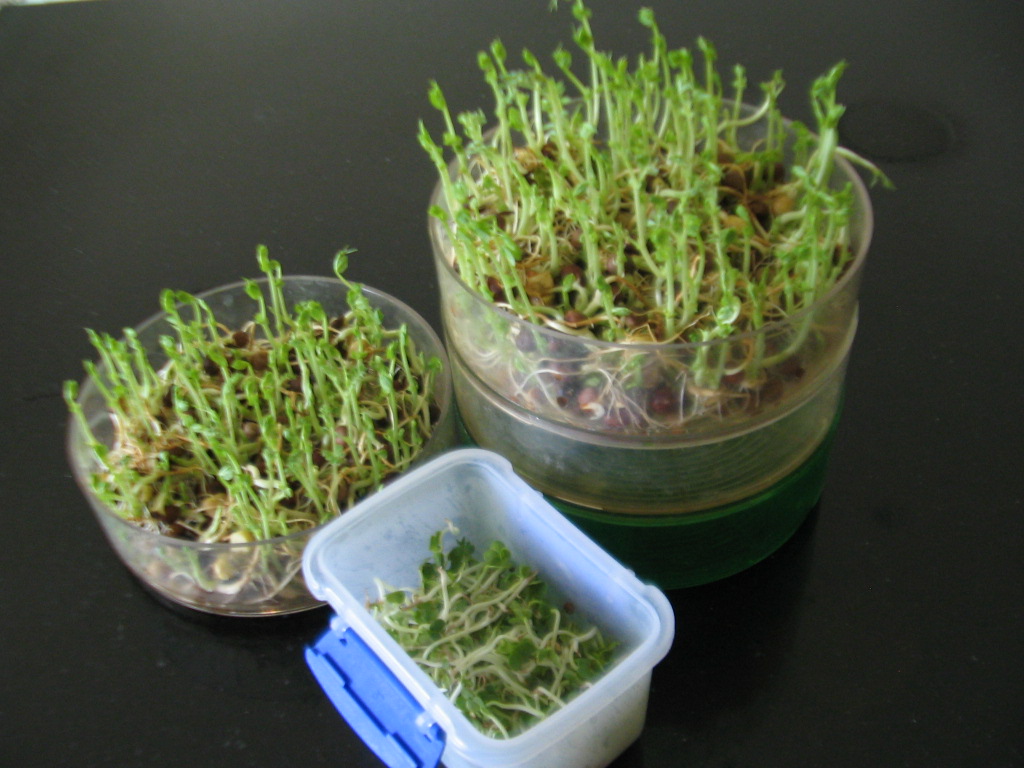 my plants survived, they are taking a little bit of time to recover and produce, and the lettuce has completely gone to seed. Even without this extreme heat, it is hard to grow lettuce or cabbages here in the hot months so….go the sprouts.
I use alfalfa, radish and mustard seed to sprout as a lettuce substitute and I use snow peas for both salads and stir fries. It takes a little more attention to grow sprouts successfully in the hot weather as any that don’t sprout are inclined to rot and smell pretty quickly, if you don’t sort them out early.
I use that little spouting system you see on the right which has a container on the bottom to catch water. Usually, I lightly cover the bottom of one tray with the alfalfa mix and bottom of another with the snow peas then by the time the alafalfa mix is ready to use, the snow peas are too tall (as in the photo) to be confined in a middle tray any more. The alfalfa takes about three days before use, but the snow peas take about two days longer. These will grow and thicken quite a bit in the next two days, whereas the alfalfa in the container will be stored in the fridge for use in sandwiches for the next couple of days and I can use the tray to start another lot, or I could have one going already. There are 4 trays.
The larger seeds like the snow peas or mung beans, I also like to soak for a couple of hours to overnight to give them a bit of a head start as well, but I find it is not necessary for the small seeds.
So why go to all this bother? There is an excellent article at :
http://www.care2.com/greenliving/10-reasons-to-eat-sprouts.html#ixzz2I6s3bvYn which gives ten health reasons for eating sprouts but I have a few others.
I get my seed sent out from http://www.livingapartment.com.au/Products/Seeds-for-Sprouting which seems to work out fairly reasonably.
I have had kale in the garden, the first time I’ve grown it but I will definitely be putting more in. I had it planted near the silverbeet and often picked them and steamed them together, putting just a little bit of lemon juice on top before they were served.
Apart from the fact that they both have an incredibly long season and so are a very useful and hassle free vegetable, they look so wonderful in the garden among the other plants.
The kale is the silver plant on the right with young silverbeet to it’s left.
But now the kale is looking a bit worse for wear and it is not just because the bugs are eating it. We have had an incredibly hot couple of weeks and kale gets bitter under hot conditions so for the moment, until I replant in February, it is vale kale.
I will leave you with this message:
Kale is one of the healthiest vegetables http://www.whfoods.com/
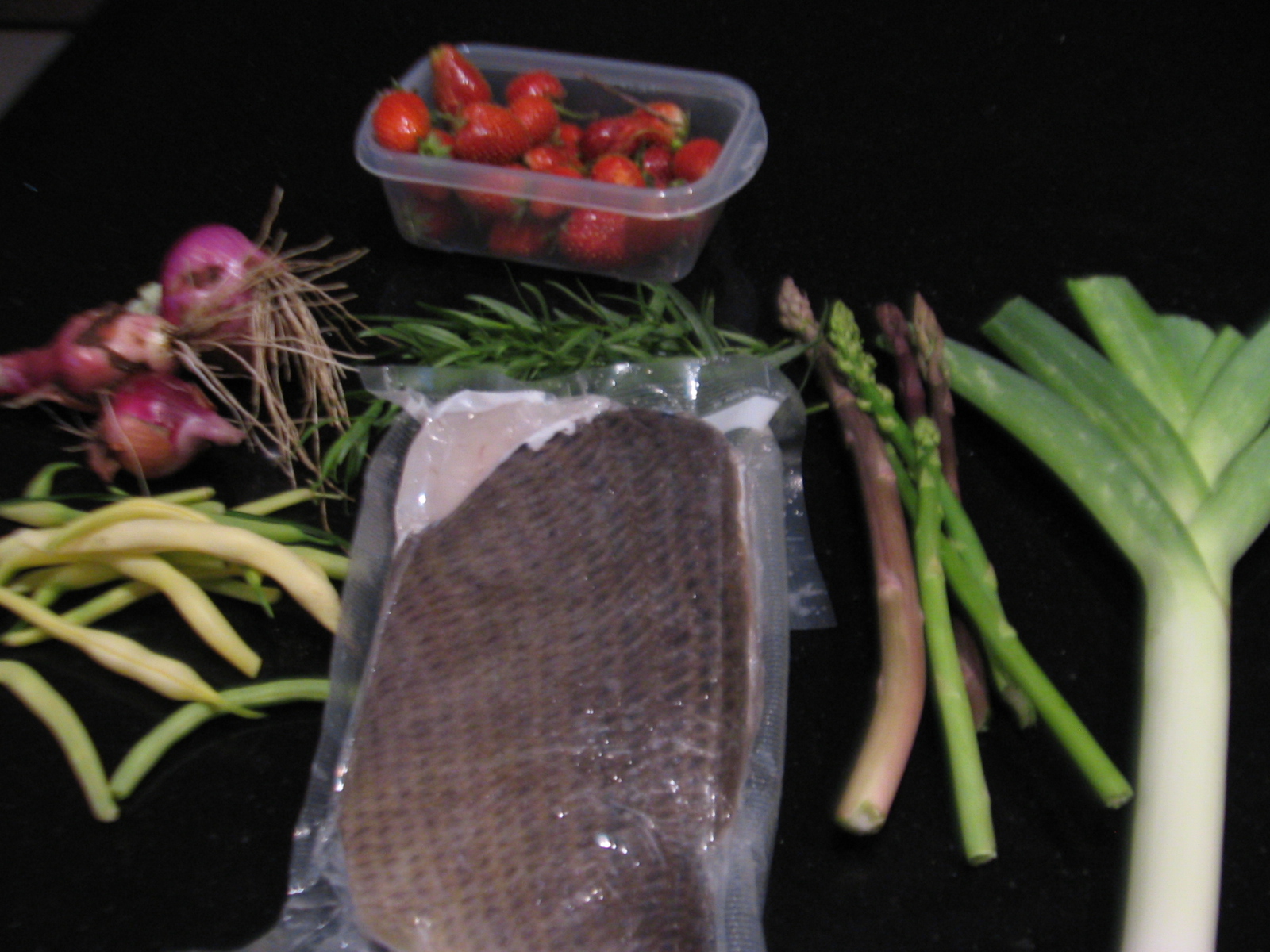
November bounty
Onions are very good for you and have been used by many cultures for their health benefits and apparently they are the world’s biggest horticultural crop, after tomatoes.
According to this website:
http://www.vegetarian-nutrition.info/updates/onions.php
health benefits include relief from asthma, coughs, colds, cardiovascular problems and stomach cancer.
So, I will happily be putting my little red onions on my sandwiches, in my salads and anywhere else I can use them. There are lots in the garden and since I planted them a bit close, I am picking out the bigger ones now to allow the others to grow.
This collection of garden produce above (and the red throat emperor caught by my husband) became Emperor with red onion and tarragon in white wine sauce.
I have only just discovered Tarragon. I didn’t realise what it was that I love so much in the occasional dish we had eaten out, but now I do know, I will be using a lot more of it.
There have been a mile of strawberries this season and this year they have a particularly sweet, toffee smell. We have them for breakfast every morning, but we have had so many that this lot teamed up with maple syrup and home- made ice-cream for dessert. I love strawberry season!!
I’m told that you never let parsley go to seed, so every now and again it needs to be cut back, especially in spring.

Tabbouleh using quinoa
So, fighting off the mating brown snakes in the garden, I did that and then decided to make tabbouleh with the cuttings.
I’m not a great fan of tabbouleh usually, especially the commercial variety but I found this recipe at http://allrecipes.com.au/recipe/4827/quinoa-tabbouleh.aspx
and it is really good. It uses quinoa instead of burghul and quite a lot of lemon juice.
Parsley has a lot of health benefits including being full of anti-oxidents but you can find them out for yourself by visiting http://www.nutrition-and-you.com/parsley.html
I think the leek is a seriously underestimated vegetable.! Seriously! Underestimated!

A retooned leek
Everyone I speak to about leeks says ‘They’re supposed to be good in a stew or something aren’t they?’ Yes they are good in a casserole, or a warm vegetable salad, but they are even better as a simple steamed vegetable with a little bit of pepper for extra taste.
Leeks make wonderful soups, whether they are part of a potato and leek soup for example or as a clear soup on their own.
They have the distinction of being a great diuretic, so if you do have a bit of bloating, a bowl or two of leek soup or leeks for dinner at night regularly will probably help. This is definitely a tastier way to go than taking pills, unless you really have to, of course.
In the garden, the leek is easy to grow and always looks good, nice and tidy. I usually plant them in mid-year as seedlings, and they take 6 months or so to really produce. The good thing about them is that they can stay in the ground for ages, and you can pick them off one at a time. The other good thing, is that sometimes you can get a retoon. I don’t pull them up, I cut them off at the base and as you see in the photo, they will reshoot. The ready-to-eat leek in the photo, is one that reshot from last year.

A previously cut leek
If you don’t get around to picking them, then they will usually seed in the second year, and the result can be seen in the third photo- from the crop that I planted two years ago.
Not everyone loves the randomness of leaving things to grow where they seed themselves, so you may want to transplant these little opportunity babies.

Self seeded leeks


 Garden Path Food