Here I am again with Suzi’s blog site but this is interesting for everyone not just those on Insulin!!!!
http://regularsuzihomemaker.wordpress.com/2013/03/02/its-been-awhile/#comments
Here I am again with Suzi’s blog site but this is interesting for everyone not just those on Insulin!!!!
http://regularsuzihomemaker.wordpress.com/2013/03/02/its-been-awhile/#comments
You know what? I grew every vegetable in this vegetable package and they are all in season. There is squash, sweet potato, red onion, butter beans, capsicum, tomato, pumpkin, chives and garlic and I added a tiny bit of chili for extra flavour.
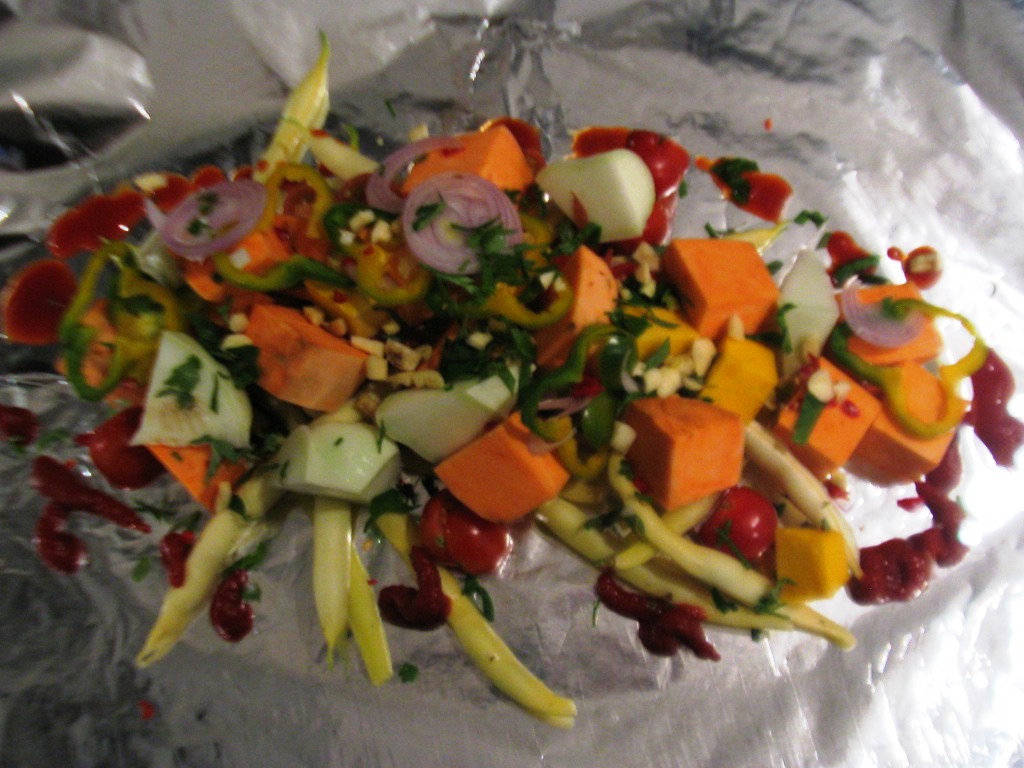
Vegetable Packages
The red around the outside is a little bit of tomato paste, then you wrap it in aluminium foil and pop it in the oven. This is the easiest way to cook vegetables perfectly and there is no washing up. This is for those times when you just don’t want to think about yet another meal, or you have lots of odd veges and you don’t want to wash up.
This is the best time of the year for tomatoes here, once the hot season is over and before the frosts. I have beautiful, absolutely perfect tomatoes with no blemishes and no fruit fly, but really the summer salad season is over so I need to find other uses than lots of salad. Over the real summer, I had grape or cherry tomatoes which are much tougher and more pest resistant than Romas or Grosse Lisse but now I have wonderful quantities of the larger varieties. I will be making tomato paste but in the meantime there will be lot’s of tomato gravies and these beautiful vegetable packages with tomato flavour.
Linus would be delighted that ‘The Great Pumpkin(s) ‘ are rising from the pumpkin patch but he might not be so happy if he knew that I  fully intend to eat every one of them using the multitude of culinary variations available to me. Pumpkin is the most sensual of vegetables. You can roast it and have that crisp, rich exterior surrounding smooth, creamy, comforting, sweet and deep flavoured flesh. This is wonderful with meat and vegetables and spectacular in a cold or warm salad, especially with grilled or pan-fried haloumi.
Pumpkin is an amazing colour and half the pleasure of pumpkin soup is the satisfying burnt orange fire colour on a cold evening. Pumpkin can be sweet, it can be savoury, used for dessert or used for a main.
And here, they are so easy to grow. Basically I live on a sand hill, admittedly red sand, and the pumpkins love it. They come up in places I have never planted them and colonise the back paddock. This morning I traded with a friend for eggs, so I hope her chooks keep on laying because my pumpkins just keep on producing.
I found out the other day that you can eat pumpkins at just about any stage of growth, even when they are quite young and small. If you had a large patch and planted as soon as the frosts are over, you could have a very long season, as pumpkins will also keep for a long time after they are picked, provided they are in good condition when you pick them, preferably on a dry day and you cut it so a small part of the stalk is attached. I have kept them for months this way.
Yes, pumpkins take up a lot of room, but they have such a long season, great storage and can be used in so many ways that they are well worth sacrificing a bit of space in return for the assurance of great, home grown produce for a many months of the year.
Every year, I make pumpkin soup and one of the best recipes ever is the Moroccan Pumpkin soup recipe I have included on my new recipe page.
Enjoy!
It’s been awhile….This is re-pressed from RegularSuziHomemaker ‘The Whole Journey’ and is a must read if you have any connection to anyone with Type1 diabetes.
Suzi is my daughter and has made the switch to a Plant Based diet. She is very carefully monitoring her insulin levels and general health as is essential for management of diabetes. She has an advantage over most of us, in that she has regular blood tests and check ups and so can get a pretty fair idea of what effect this diet has on her system.
If you have an interest in nutrition for any lifestyle or health issue, you will find this interesting. ‘The Whole Journey’ also has some amazing recipes and food choices for those of us who just appreciate a few more vegies in our diet than most people do.
I would have to say that squash and eggplant were not vegetables I was introduced to when I was young, and it has taken a while for me to learn to cook with them and even longer for my husband to learn to eat them.
This photo is my harvest for December and you will see both eggplant and a giant squash. These really should be only about 8 cm across, but mine are like small pumpkins.
They are extremely edible though, rather like young choko, and like choko, they only take a few minutes to steam. I suspect they go completely to mush if they are cooked much longer, which is probably why a lot of people hate them.
I have come to the conclusion that the previous generation’s tendency to cook vegetables to mush was probably because so many of them had false teeth and hate chewing.
Eggplant is one of the most versatile vegetables out and the newer varieties don’t need to be salted to get rid of bitterness the way some of the older one’s did. I still do though, just putting the sliced eggplant in a dish with salt for 1/2 an hour or so and then washing it off before I use it.
The night this photo was taken, I had cooked it by rolling it in egg and rice crumbs, then frying (yes frying) it with crumbed whiting. It soaked up the oil and the fish flavour and was amazing.
I also often use it in rissoles or tacos or spag bog, any mince dish, to reduce the amount of meat and improve the texture.
I’m told that you never let parsley go to seed, so every now and again it needs to be cut back, especially in spring.

Tabbouleh using quinoa
So, fighting off the mating brown snakes in the garden, I did that and then decided to make tabbouleh with the cuttings.
I’m not a great fan of tabbouleh usually, especially the commercial variety but I found this recipe at http://allrecipes.com.au/recipe/4827/quinoa-tabbouleh.aspx
and it is really good. It uses quinoa instead of burghul and quite a lot of lemon juice.
Parsley has a lot of health benefits including being full of anti-oxidents but you can find them out for yourself by visiting http://www.nutrition-and-you.com/parsley.html

Today’s Haul
This was the basis for our dinner tonight. All of these things are most definitely in season at home at the moment. As my husbands says ‘Something that cooks up as dark and fresh looking as the silverbeet, has to be good for you.’
I usually add a tiny bit of fresh lemon juice to the kale and silverbeet after cooking since I like the tang that it adds.
This lovely fresh asparagus requires nothing of course and can be eaten raw in salads or very lightly steamed with the other greens.
We usually eat the leeks lightly steamed but I know a lot of people only eat them in casseroles. We love them just as they are as a vegetable in their own right.
What do you do with leeks?
Since my original thyme bush was looking a little time-worn, I couldn’t resist this beautiful little specimen of lemon thyme. It is such an attractive little plant and has that wonderful tangy thyme smell with a touch of lemon.
We have recently filled the freezer with winter whiting caught off the Fraser Coast, and lemon thyme seemed like it could be a great complement to whitefish. I tried it the other night with a little bit of chives and poached in a white wine stock.
My other thyme bush has come back after a heavy trimming, so I will still have ordinary thyme to use in my scrambled eggs as well.
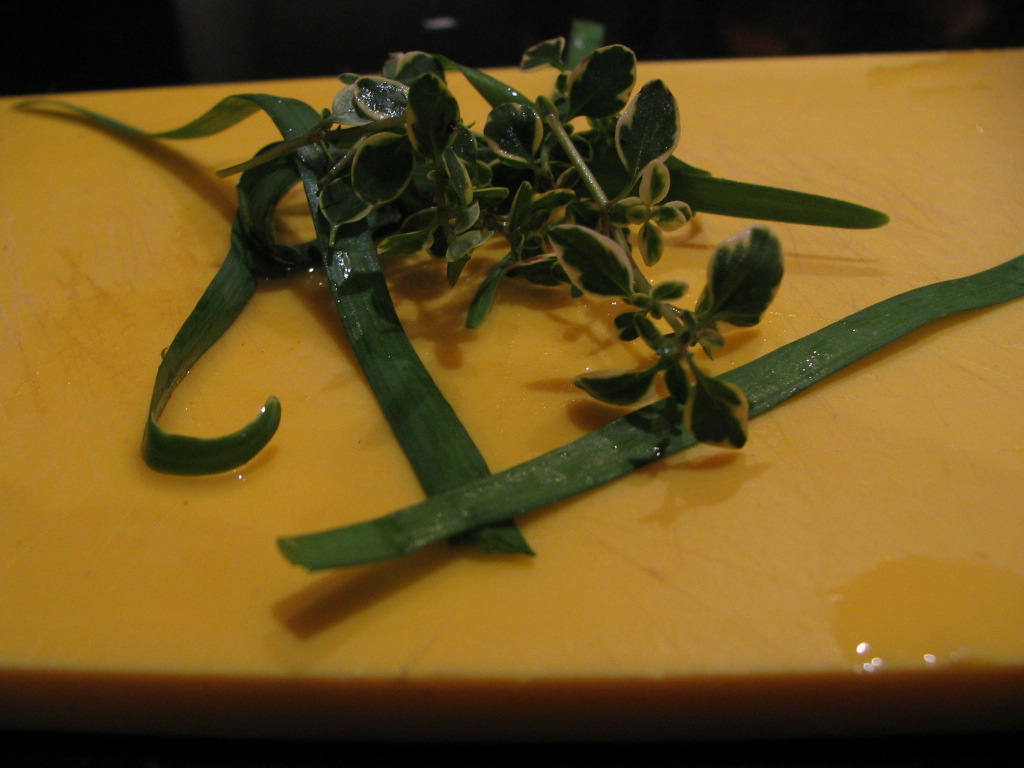
Lemon thyme and chives for the fish

Lemon Thyme
There is a lot of discussion about foods and diet and everyone has a story about what works for them.
A great book which discusses why different foods are good for different people is ‘Food and Healing’ by Anne Marie Colbin put out by Ballantine Books.
The Blog www.regularsuzihomemaker.wordpress.com follows the fortunes of one young adventurer in to whole foods, and also has recipes for the the great meals she makes along the way.
 We had mackerel for dinner, the last of last year’s catch. Since it is not my favourite fish and it was not real fresh, I was finding it hard to be inspired by it.
A five minute walk in the garden gave me an answer.
Chinese cabbage, capsicum, spring onion and water chestnut added up to some sort of stir fry and plenty of opportunity to disguise the mackerel a little and increase the fresh vegetable content.
Not bad at all.


 Garden Path Food